Theoretically I Love Freedom
Chelsea Hodson & Wendy C. OrtizIssue 1
Interview
The first time I met Wendy C. Ortiz was at AWP 2015 in Minneapolis. I met her at the bookfair during the day, and I was excited to meet her after obsessing over her memoir, Excavation. That night, I felt frazzled from talking with people all day long, but when I saw Wendy, she seemed totally relaxed and at ease. I did what any normal person would do—I asked to touch her forearm so I could “siphon” some of her “calm energy.” She said yes, it worked, and we’ve been friends ever since. She lives in Los Angeles, I live in Brooklyn, so we decided to keep in touch in 2017 via a “year-long interview.” Beginning in January, we took turns, devoting one month at a time to answer and ask a question of the other. This is the result.
—Chelsea Hodson, December 2017
When I proposed the idea of a year-long interview to Chelsea, one of my intentions was to formalize a relationship that has been mainly in the air and of the air (online) with a few (for me) electric moments in one another’s corporeal presence. I had an instinct that Chelsea might appreciate the constraint of the concept and that we both might also appreciate the length and the format. I’m honored that she was game.
—Wendy C. Ortiz, December 2017
(January 1, 2017) Wendy C. Ortiz:
How would you describe your relationship to regret?
(January) Chelsea Hodson:
I almost never regret anything—I feel grateful for both the good and the bad. Doing the wrong thing (again and again) has taught me the most important lessons of my life. I’m not sure I’ve ever learned from something that made me happy. Knowing this softens the blow of regret.
I’m freed by the fact that I don’t believe “everything happens for a reason.” I believe humans are reckless and impulsive, so assigning meaning to something seems like a choice. I’ve decided my mistakes are meaningful to me.
Do you regret things? What kinds of events or details from your life do you deem important enough to write down in a journal (or elsewhere)?
(February) Wendy C. Ortiz:
I keep coming back to “almost never”—intriguing. I’ve thought all month about your response, mostly asking myself, do I feel like things happen for a reason? I think I’m mostly free of that. But I do follow synchronicities that appear and more appear the more I follow—but it feels less like things happening for a reason and more like, There’s more here than what’s happening on the surface. And looking at events in retrospect often underlines that feeling.
Humans are reckless and impulsive, yes! And it’s interesting to me to see what happens when intention does and does not come into (conscious) play.
I remember once you tweeted a line of mine from Hollywood Notebook, about loss, and wanting to wear out the subject. My loss notebook could also be considered a mistakes notebook.
I’ve been told by more than one person who loves me that I seem to operate on no regrets. The first time I heard that I started asking myself, Is this true. But I do regret things. I regret a couple of major things. But one of them was a crucible that felt necessary to undergo. And the other I’m slowly starting to understand and become more neutral about.
In terms of my journals, it’s mostly a dumping ground of whatever. I do consistently note emotional shifts and occasionally dialogue I want to remember. So some events make it in (because they result in emotional shifts) and other times events are missing but there’s tonal evidence that something was shifting, even if I don’t spell it out.
I’ve always thought of your Inventory project as a kind of visual public journal. Do you keep journals? How do you deem what’s important enough to document there or elsewhere?
THIS IS ONE OF THE ONLY SOURCES OF TRUE PLEASURE FOR ME: TELLING MY SIDE OF THE STORY AS PERFECTLY AS I CAN.
(March) Chelsea Hodson:
Inventory is the closest I’ve come to keeping a daily journal for a long period of time (one paragraph per day for 657 days straight). I’m constantly starting and abandoning a regular journal—usually at least twice a year, for a few weeks or months each time. When I do this, I think of Sarah Manguso’s line from Ongoingness: “And then I think I don’t need to write anything down. Everything that’s happened has left its little wound.” I’m often romantic, but I’m hardly ever sentimental—I get rid of possessions all the time, and I’m content leaving many things unwritten. And when I finally do write them down, it’s so satisfying to see my life in a neat little box made of words.
This is one of the only sources of true pleasure for me: telling my side of the story as perfectly as I can. Any journal I keep is sloppy and frustrating to me, but Inventory was tidy and daily. I often started the entry’s text with the object in mind, but then it would frequently turn personal. Only once I read aloud the series from beginning to end on the last day of the project did I see how personal and diaristic it had become—it was embarrassing to realize, actually. So, I can be disciplined, but I need a constraint, even if the writing is just for me, and I suppose the idea of a journal is so freeing to me that I don’t even know what to do with it. Things I frequently write down are: lines of dialogue that strike me as particularly beautiful or insightful, dreams about people I hardly ever see but seem to live in my subconscious, and concepts for future projects.
Do you experience this sensation of satisfaction in writing something down as perfectly as you can? What non-writing things do you do that you feel are satisfying to you? I know you often hike to the Griffith Observatory—is that more satisfying than writing? Sometimes I really hate how quiet and stagnant the act of writing can feel, especially when I remember so much of it lives inside my computer.
(April) Wendy C. Ortiz:
Of the things you frequently write down: I would love to read all of those unedited.
The sensation of satisfaction is completely there, it’s what I am going after. It’s what I mourn when I can’t quite catch it. More satisfying than writing—this changes for me over time, but where I am now, hiking is more satisfying, anything I can do with my body is far more satisfying than writing—it’s like finally figuring out that I can get certain needs and desires met in this completely safe and neutral way. Just make your body do this (on the trail, on the waves, etc.). Also, my fantasy life is pretty rich and way more satisfying than writing something down as perfectly as I can. But then I try to write that out and find it mostly unwriteable, for now.
My journals, too, are super sloppy. They’re like the marsh I’m cutting through with my machete. The dredge.
How do you integrate the experience of when the act of writing is quiet or stagnant? What do you do (if anything) in response? I’m also curious about what non-writing things you do that you feel are satisfying to you. (I love this word “satisfying”—it can hold so much and so little, it feels balanced, though, unlike if I ask you, what non-writing things hold you in their grip and threaten to sweetly undo you?)
(May) Chelsea Hodson:
I loved going to Griffith Observatory when I lived in Los Angeles, but I hate being in the sun, so I’d always go at night and I’d take the much less scenic paved road instead of the hike you do. Now I mostly work out at a gym near Bryant Park (near the library I do most of my writing and research in). I use running like a reward, because it is so much more “satisfying” than writing to me, for the most part. Writing can be rewarding in many ways, but it’s never made me feel literally strong the way that running does, and it also helps my anxiety. Another thing I do to combat the quiet of writing is playing guitar and singing. I do this softly and privately (an unplugged electric guitar in my room), but it still feels much different than the silence of typing into a machine. However, the most satisfying of all to me is organizing my room. Not cleaning, necessarily, but getting rid of things, meticulously organizing drawers, and so on. It gives me a feeling of control and efficiency—the same feeling I get when writing goes well, but of course it doesn’t always go well.
In terms of what non-writing things hold me in their grip: fantasy and longing. I’ve made those things part of my writing because they are so much a part of me, but only recently have I learned how destructive they can be (and I can be). I like the phrasing you’ve used: “threaten to sweetly undo you.” I very recently feel I was undone—however, the unraveling wasn’t as sweet as I’d have liked it to be. It was almost unbearable, actually, but here I am. So many “un” words: unravel, undone, unbearable (and from your question: “unwriteable”). It’s that cliche of playing with fire, getting burned, etc. But what if I am the fire? (Unlit, and then unstoppable.)
I recently watched Author, the documentary about J.T. LeRoy, and have been thinking a lot about the element of persona in writing, especially nonfiction and memoir. I’m curious if you think about this at all in your writing—do you see your writing voice as a persona in some sense? Or do you see it as a previous version of yourself (if you’re writing about events that occurred decades ago, for instance), or do you generally see it as “true” to yourself as you can be? Or perhaps all of the above?
I’M VERY INTERESTED IN THE DESTRUCTIVENESS OF FANTASY AND LONGING. IT’S AN AREA WHERE I’VE HAD TO DO A LOT OF GROWTH PERSONALLY.
(June) Wendy C. Ortiz:
Ahhhh, I have to see that documentary! I had such a preoccupation for a while with J.T. LeRoy before everything came to light. I think about persona a lot—and it comes up when I teach my brief workshop “Public Notebook to Book” because part of that process are the personas I work with internally and externally. My writing voices represent different parts of myself. I always have those previous selves lingering somewhere in me and sometimes they find expression. Still, every time I work with a part, whether it’s the 14-year-old or the 24-year-old in me, I’m always trying to get as close to her truth as possible. Her truths might not be the same as 44-year-old me who is doing the reflecting and writing but it’s where the charge is. There’s a good friction there sometimes.
I relate very much to what you describe in terms of running, fantasy, and longing, and also the act of purging (you didn’t call it that, but how you describe organizing and getting rid of things is an act I participate in regularly, which I think of as “purging”). This doesn’t totally surprise me, as I feel I’ve always had a warm, easy, and yet depthful (??) rapport with you—so of course we’d find some similarities in this way (I also love that your preference is running at night versus my preference of morning).
I’m very interested in the destructiveness of fantasy and longing. It’s an area where I’ve had to do a lot of growth personally. In fact, one of my recent tarot readings gave me a strong reminder that I need to focus more on what’s in front of me, here and now—at least for now! I love writing from that place of fantasy and longing as well—my experience of that is that sometimes it invokes the very things I long for and fantasize about. This is exciting, dangerous, and, I’ve found, has to be used with intention and consciousness. How do you go about writing in/through fantasy and longing? Is it possible to avoid the destruction that threatens? What do you make of your own (potential for) destructiveness, and can it, does it, will it find its way into your work (more)?
“...but here I am”, you say—and I am so glad you are.
I’VE DEFINITELY FELT THAT MY WRITING AND OBSESSING OVER SOMETHING OR SOMEONE HAS CONJURED THAT EXACT THING OR PERSON IN A WAY THAT’S BEYOND EXPLANATION.
(July) Chelsea Hodson:
I’m late responding this month because these questions are genuinely scary to me—it’s like I read them and immediately turned away. I’ve definitely felt that my writing and obsessing over something or someone has conjured that exact thing or person in a way that’s beyond explanation. I guess that means it’s either coincidence or magic. Once, after a week of writing really vividly about my ex I hadn’t seen in years, I ran into him on the street. A similar thing happened when I was writing about David Blaine holding his breath for 18 minutes—I saw him walking in Manhattan a few days later. I have other, longer stories like this. I tend to believe that people generally find what they’re looking for, so it seems inevitable that obsessions would materialize eventually. I don’t think it has to do with writing, necessarily, that’s just how it plays out for me, especially in terms of obsession. I’m interested in self-destruction, and that happens to be the easiest thing to find. It’s so easy it’s almost lazy.
So, I don’t really have an answer for how to avoid destruction associated with longing, and I certainly have a bad track record. But I have hope in the fact that fantasy, in itself, is not an act—it’s the longing for the act, right? There’s room to stop, but stopping is harder than letting yourself just roll along with the momentum. Plus, it’s no fun to stop. But I don’t even really like “fun,” so there’s hope for me, I think.
I’m interested in the topic of the workshop you mentioned—about turning a public notebook into a book. How much, if at all, do you consider your readers when you are writing a book, or curating a notebook into a published book? Does the public element of it feel inhibiting or freeing to you? Are you ever surprised by the reactions readers have to your books?
(August) Wendy C. Ortiz:
What you’re saying is reminding me about past obsessions and how often I was satisfied with the longing/how often I was satisfied with the act.
I never think of myself as having readers, plural. I think of one person. That person changes over time—but that’s what it comes down to. That person may or may not be aware that I’m holding them as my reader. I’ve lost my most valued reader in the not so distant past, and the ache is real. They were a real reader. Sometimes it’s my fantasy of who I imagine will read what I’m working on.
The public element is delicious. I enjoy it because, like for instance with Tumblr, I feel I’m throwing everything into the black hole. I don’t care about responses though I find them interesting when they arrive. If I’m using Instagram to share some piece of work, I’m definitely taking the temperature of the piece. The responses are another facet of the work-in-progress. I don’t take them very personally but the responses have their uses.
Maybe it’s both inhibition and freedom that I’m wrestling with. I feel myself, the friction of myself between those two. Inhibition is like a constraint. I love constraints. Theoretically I love freedom, too. Ha.
I’m always surprised at readers’ reactions to my books. Always. Maybe this comes from never having assumptions about who is reading my books, or why. When reactions are shared with me, it’s a constant, “Oh!” Occasionally someone will offer an insight into something about my experiences as related in books that I haven’t already contemplated myself, and that’s always a bit alarming. Maybe I’m most surprised, though, when readers take the feelings they have about the story, or the themes I write about, and assume we’re on a special wavelength together. Often this will play out with them showing no understanding of basic boundaries. I mean, I notice when this happens to me with a few books, but I typically refrain from contacting the author with my belief that we are on a special wavelength together!
Which leads me to this question: Are you ever surprised by readers’ reactions to your work? How do you engage, if at all?
(September) Chelsea Hodson:
I don’t have to engage much at the moment, since I still don’t feel I’ve published much—two chapbooks, a blog, a few poems and essays here and there. I remember, years ago, feeling totally desperate to put my work in the world—a sense of real panic that I might not have what it takes to be a “real” artist. The only way I was able to feel legitimate for about two years was to receive a rejection letter now and then, because at least that was acknowledging my attempt to do something worthwhile. But then I hit a stride of sorts after publishing Pity the Animal, and I began keeping everything private, choosing to keep my essays to myself instead of publish them one by one. As a result, I’m months away from publishing a book only a handful of people have read.
When Pity the Animal was published, I was thrilled to hear from people that saw themselves in it. It was really scary and humiliating to write about desire in such a specific way, so it was surprising to see others appreciating it, too. The only thing that really bothers me is when strangers think I should be immediately accessible to them just because they’ve read my work. Despite how I may seem in my writing, I’m very private, so people often end up disappointed if they come to me looking for elaborations on something they’ve read. However, I definitely understand the “special wavelength” feeling, and I actually write a decent amount of fan letters, too. Life is lonely—it’s only natural to want to reach out.
You mentioned constraints—do you ever use constraints to kind of trick yourself into writing? I find that, even after years of writing, I have to constantly come up with new tricks and rules to keep myself unafraid of working.
CONSTRAINTS ARE ALSO “ASSIGNMENTS” AND ASSIGNMENTS ARE EXPERIMENTS, AND I LOVE A GOOD EXPERIMENT WHETHER IT FAILS OR NOT AND I LOVE A GOOD ASSIGNMENT BECAUSE OF THE FEELING OF ACCOMPLISHMENT THAT COMES WITH HAVING “COMPLETED AN ASSIGNMENT.”
(October) Wendy C. Ortiz:
I deeply admire the way you perform privacy (I mean that in the sense that as a reader and observer of social media, I see how you draw boundaries and this to me is a good model for how to be private). It’s funny to me that people expect elaborations on something they’ve read. As ironic as this to say in the middle of an “interview” (though slightly unconventional, and present company is held in highest esteem!) I have to say I’m kind of over interviews. Or, I have higher expectations of people who want to interview me (the same people who expect elaborations).
About constraints… they operate as prompts to me… and I see prompts everywhere. Constraints are good for me. I like riding up against a constraint and the friction is where I think the gold is… and I also like being contained, so constraints offer my psyche a lot to enjoy. Constraints are also “assignments” and assignments are experiments, and I love a good experiment whether it fails or not and I love a good assignment because of the feeling of accomplishment that comes with having “completed an assignment.” When I think of my own writing and which writing I feel has been the most satisfying, maybe “the best” from my perspective, the pieces were constraint-based and came from outside of me.
I wonder what you think about this interview, what it’s been like for you now that we’re in the eleventh month. Can you imagine where it might live, if outside of this Google doc? Does it die when we close the document up? Is the year our constraint?
(November) Chelsea Hodson:
Before I even read your response this month, this was the question on my mind as well—what will happen to our interview? Seeing something through to its end is often the only real source of satisfaction for me, so I like the thought of finishing our year of formal conversation and then letting it live elsewhere. I’ve recently acknowledged how quickly things change without any warning—publications shut down, jobs change, friends become strangers—it’s made me hyper-aware of tying up loose ends. I like things sealed and delivered so that it makes room for new ideas in my mind.
I think I’d like to end with someone else’s words that are stuck in my head. Does that ever happen to you? A sentence or passage swirling around like a pop song? This is one of my favorite things I read this year, and I think you might like it, too: “Awaken; return to yourself. Now, no longer asleep, knowing they were only dreams, clear-headed again, treat everything around you as a dream” (Marcus Aurelius, Meditations). It gives me immense comfort to read that, knowing it’s two thousand years old. Is there a sentence or a passage that’s stuck in your head?
(December) Wendy C. Ortiz:
I do like that, and I feel like I just recently came across a reference to Meditations elsewhere recently.
What of the loose ends? I feel like I’m constantly on a path of having to become more comfortable with loose ends, un-endings, detours, and minor derailment. Pauses.
There has not been a recent sentence or passage I’ve been repeating to myself, just the ones I’ve repeated for years and years. This, from Michael Ondaatje’s Handwriting (which I keep by my bedside and have memorized parts of):
Love arrives and dies in all disguises
and we fear to move
because of old darknesses
or childhood danger
So our withdrawing words
our skating hearts
These lines remind me that people are often operating from places we can’t discern completely, so be gentle when possible. These lines also remind me of who I’ve been, who I am, who I hope to be. So I guess it’s a reminder of gentleness to self, too.
Chelsea Hodson is the author of the forthcoming essay collection Tonight I’m Someone Else and the chapbook Pity the Animal. She teaches at Catapult and lives in Brooklyn.
Wendy C. Ortiz is the author of Excavation: A Memoir, Hollywood Notebook, and the dreamoir Bruja. She is a psychotherapist in private practice in Los Angeles.
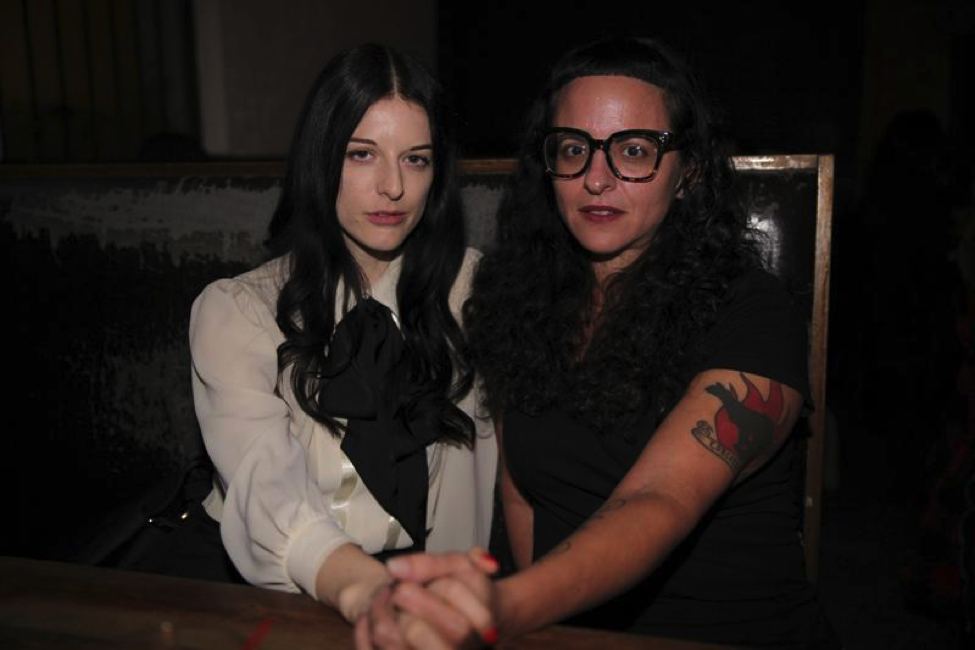
Photo: Chelsea Hodson and Wendy C. Ortiz at Franklin Park Reading Series in November 2016. Photo by Taji Ameen.